
Wood Fiber and PittMoss Blends
Some preliminary trials were performed in the pursuit of producing more sustainable growing substrates for horticultural use. This project evaluated the effects of wood fiber on aeration, water availability, and nutrient retention in blends with PittMoss. In these tests, PittMoss, wood fiber, and Sphagnum Peat were compared alone and when combined as blends of 50% PittMoss with 50% wood fiber, 67% Sphagnum with 33% wood fiber, and 33% PittMoss with 33% wood fiber and 33% Sphagnum. The PittMoss was Grower Grade, while the Sphagnum was Lambert standard retail grade, and the wood fiber was standard grade obtained from a grower. All sample blends were hand mixed at moderate but low moisture content and run through a ¼ inch screen to ensure uniform mixing with no clumping.
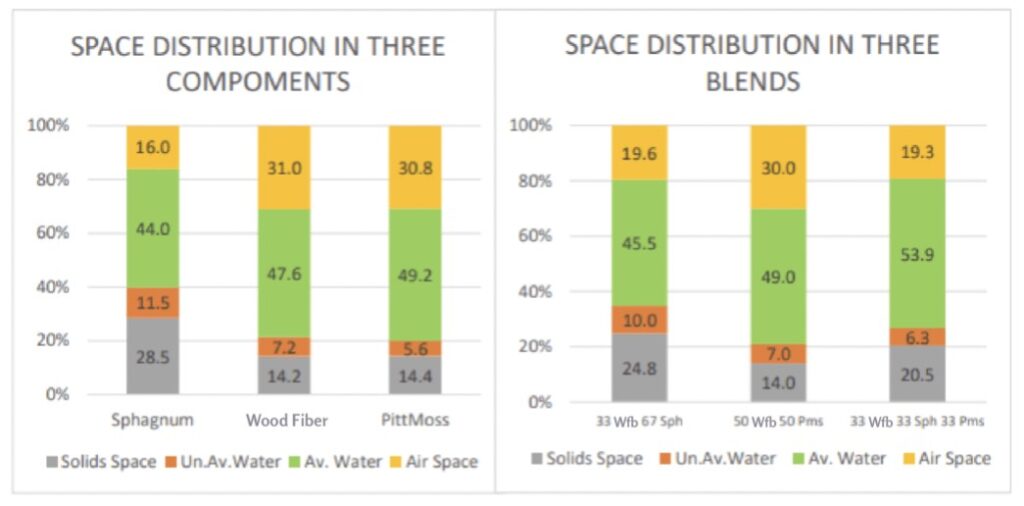
Air space and water retention were measured using cup-in-cup methods, which involves letting the samples saturate for 24 hours and collecting the drainage to make weight measurement calculations. Dry bulk density was obtained after 24 hours of drying at 205 degrees Fahrenheit. By using the collected data and estimating unavailable water (that water held at tensions greater than the roots can pull it from the blend), space distributions were calculated, applying the same methods to all components and blends. The figures below show the results. Note that these measurements were not replicated and should only be treated as observations rather than as definitive results.
Substrates Tested
1. PittMoss Grower Grade
2. Standard grade wood fiber
3. Lambert standard retail grade Sphagnum Peat
4. 50% PittMoss Grower Grade with 50% standard grade wood fiber
5. 67% Lambert standard retail grade Sphagnum with 33% standard grade wood fiber
6. 33% PittMoss Grower Grade, 33% standard grade wood fiber with 33% Lambert standard retail grade Sphagnum
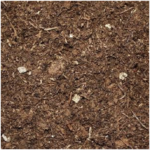
Lambert standard retail grade Sphagnum Peat
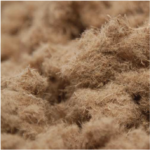
Standard grade wood fiber
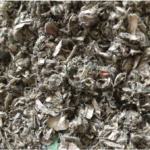
PittMoss Grower Grade
Production
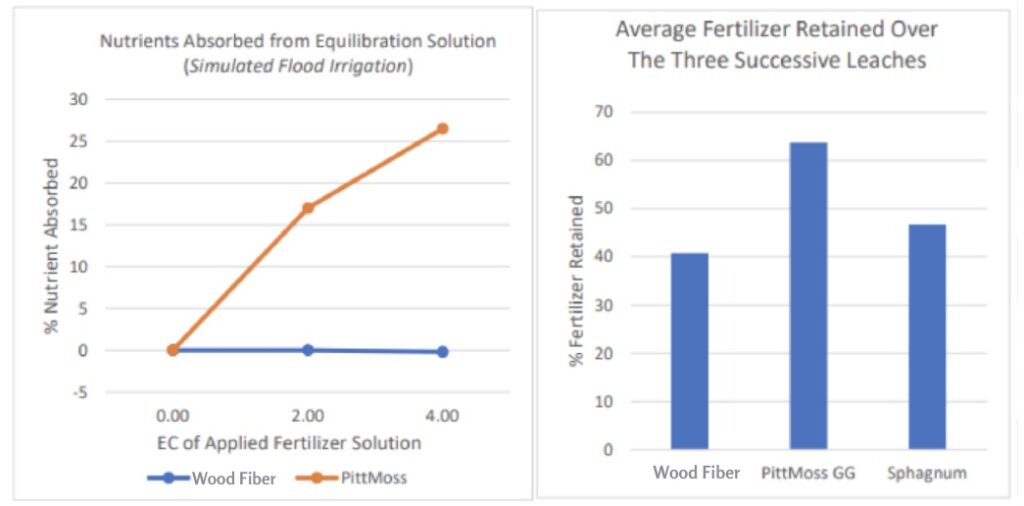
To compare the ability to absorb nutrients, 100 ml of three (distilled water based) solutions of Potassium Nitrate at successive concentrations levels (with EC measured at 0.0, 2.0, and 4.0) were added to 100 ml of fully moistened PittMoss and wood fiber. Once the samples equilibrated for 24 hours and were drained, the EC (soluble salts) of the drained solutions were then measured. Following this procedure, three more successive equilibrations with 100 ml of added distilled water were conducted. They were equilibrated for 30 minutes and drained, with the drainage (leachate) measured after each successive equilibration. The data for the samples’ ability to absorb nutrients and the ability to retain those nutrients against leaching are presented below.
Comparisons
The findings give us four areas of comparison, and we can make some observations about each.
- SPACE DISTRIBUTION IN THE COMPONENTS
- Total Pore Space (water & air) is about the same for wood fiber and PittMoss but less for Sphagnum
- Available Water is a little greater in PittMoss than in wood fiber, and both are much greater than in Sphagnum.
- Air Space, when saturated and drained, is about the same for wood fiber and PittMoss.
- SPACE DISTRIBUTION IN THE BLENDS
- The 33% wood fiber 33% Sphagnum 33% PittMoss showed the very best Available Water, while still having good Air Space.
- The 50% wood fiber with 50% PittMoss gave increased Air Space at about 30%.
- Solids Space and Unavailable Water are much higher in the 50% wood fiber and 50% Sphagnum blend.
- ABSORPTION OF NUTRIENTS
- PittMoss absorbed 27% of the nutrients when applied at the higher rates.
- Wood fiber failed to absorb the nutrients but apparently held some in the retained solution.
- RETENTION AGAINST LEACHING
- The greatest retention of nutrients in this trial was within the PittMoss.
- The poorest retention of nutrients in this trial was within the wood fiber.
Summary
An additional observation was the apparent structural resilience against compaction that the wood fiber adds to PittMoss. This trial demonstrated the exceptionally high porosity in the PittMoss-wood fiber blends. The water and nutrient holding properties of PittMoss make up for the nutritional weaknesses of the wood fiber. Also, keeping quality or shelf life should be returned to normal when PittMoss is added to the wood fiber-Sphagnum blends. These observations make a good argument for a combined blend of PittMoss and wood fiber. Significant evaluations and trials should be performed to further test the best blend rates when combined with Sphagnum or other blend components.